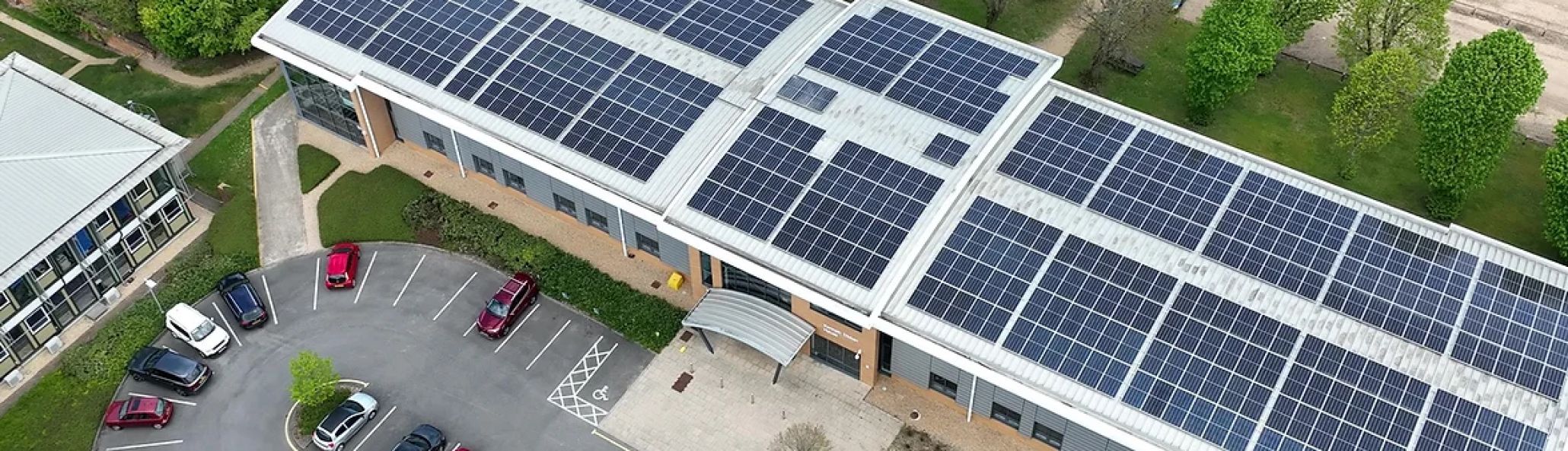
Absolar: Looking to the Skies
Absolar uses AI-based technology to conduct fast and accurate remote surveys which assess the solar potential for any building, portfolio, or even city.
Solar power is an increasingly popular choice of renewable energy to reduce carbon emissions and balance energy costs. However, taking the decision to invest in solar can be challenging due to a number of unknown factors such as the estimated return on investment, and expected carbon and cost savings.
In one example, the Royal Air Force commissioned Absolar to help it assess and quantify opportunities for solar power as part of its effort to decarbonise operations and reach net zero by 2040 (a decade ahead of target).
Absolar identified and conducted detailed assessments of potential rooftop, carport, and ground-mounted solar installations at five RAF sites. This involved surveying 1,800 rooftops and the surrounding landscape using both LiDAR and GIS analysis, predicting solar radiation at 30 minutes intervals. This timing is important as it ensures that future power generation forecasts are based on energy demand and can be cross-referenced to calculate import and export requirements for the national grid. Analysis of each survey was then performed using computer vision tools to isolate only those locations with sufficient space for solar panels and calculating the quantity that could be installed in each.
This process identified 266 RAF buildings suitable for rooftop solar installation, 11 sites for deploying ground mount solar panel installation, and 54 carports capable of conversion, ultimately revealing the opportunity to save 31,558 tonnes of carbon and over £20m per annum. Absolar is providing ongoing support to the RAF with regard to design specification to optimise this potential.
Absolar is a spin-out from the University of Southampton, putting into practice the University’s ‘Triple Helix’ approach of solving problems through collaboration with industry, local government, and academics.
Launched in 2020, Absolar received research and development support from the University, followed by mentoring through the Science Park’s Catalyst programme for early stage businesses. Since then, the company has grown and taken up residency within the Science Park’s Engineering Centre.
The company’s technology has been utilised to full effect in helping the Science Park work towards its goal of achieving net zero by 2030. In just three years, solar panels fitted to ten buildings, along with two solar trees, created an incredible 1.8-Gigawatt hours of renewable electricity; that’s enough to power 670 homes for a year. This initiative has saved 350 tonnes of carbon from the grid; a volume that would look like 1,430 double-decker buses stacked up!
solar installation planned for RAF buildings
carports capable of conversion
tonnes of carbon forecasted to be saved