
USSP Welcomes Catalyst Cohort 18
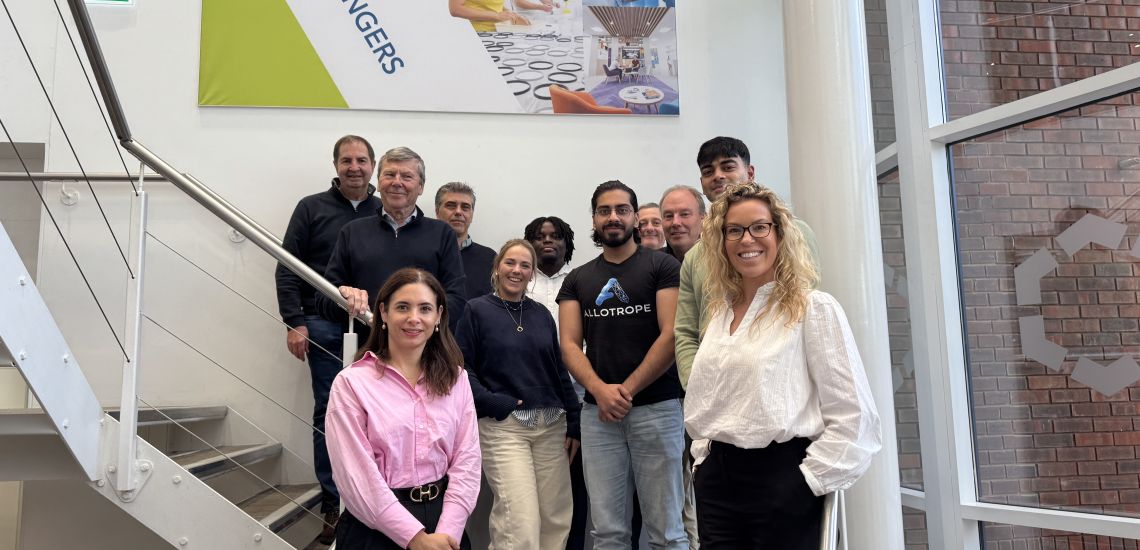
On Wednesday 30th September, Southampton Science Park proudly welcomed the 18th cohort of its acclaimed Catalyst business accelerator programme.
This cohort comprises nine early stage companies covering a broad spectrum of exciting concepts and technologies, including AI for drug discovery and clinical decision support, ocean and seabed technology, water quality testing and mosquito-borne disease prevention.
- ALLOTROPE TECH aims to help pharmaceutical companies develop new medicines faster and with less risk. Its machine learning platform predicts how drug molecules will crystallise, finding stable forms faster and flagging potentially costly problems early in development. Founders Arshia Tourani and Martynas Mickevicius said, “Catalyst gives us the opportunity to develop Allotrope within a strong scientific and entrepreneurial ecosystem and access the expertise, facilities and network needed to take the company to its next stage.”
- BIOSYSTEMS ASSURED is making water quality testing quick, easy and affordable. Its portable device empowers users with no specialist scientific training or laboratory access to detect harmful organisms within minutes, rather than waiting days for test results. The technology will help water companies, environmental agencies, port health authorities and leisure operators identify and respond quickly to sewage pollution and toxic algae. Founders Andrew Lane and James McQuillan said, “Acceptance onto Catalyst, together with recent success in grant funding, has been a very positive experience. It feels like, after many years’ hard work, everything is coming together.”
- DECISION DATA helps NHS teams improve patient safety and deliver higher quality care. Its data science toolkits turn the information hospital departments already collect into clear, actionable insight to improve quality and health equity. Its first toolkit is already in use in an NHS maternity department. Founder Emily Fraser-Mackenzie was delighted to be accepted onto the programme, commenting, “We have spent a long time building this alongside NHS clinicians and we are confident about the science, but need help turning our passion project into a viable business.”
- GALLERIABIO aims to help researchers bring promising new treatments to market much faster, and at significantly lower cost, by using insect larvae in place of traditional rodent testing during early-stage drug screening. The approach delivers rapid, ethical, in vivo screening data in just 14 to 21 days. Founder Dr Evgenia Maslova, who co-founded the business with Prof Ronan McCarthy, said, “Knowing that the Catalyst team believes in this vision makes me feel truly empowered to take the next big step in turning our research into a thriving business!”
- ISARS aims to protect people in high-risk regions from malaria and other mosquito-borne diseases, without using chemicals. Its smart acoustic device uses on-board AI to identify disease-carrying mosquitoes from the distinctive sound of their wingbeats, then emits a tailored sound signal to drive them away, constantly adapting to remain effective over time. Founder Ulrich Tanetsing was genuinely excited to be accepted, commenting, “Getting recognition from a start-up accelerator as well-regarded as Catalyst felt like real external validation of what had, until then, been a solo effort built in evenings and weekends around my MSc.”
- OHM LAB makes it easier for engineering teams to build artificial intelligence into products or operating environments where power, connectivity, latency or privacy make cloud processing difficult. Embracing edge AI, embedded systems, computer vision, intelligent sensing and industrial monitoring, the concept is being applied to real-world challenges in areas such as robotics, transport and environmental monitoring. Founders Mukund Srinivasa Raghavan and Hamish Morley said, “We have shown that we can build and sell advanced technology, and Catalyst gives us the structured coaching and network needed to turn that capability into a focused and scalable business.”
- OSCAR TECHNOLOGIES aims to reduce cost, size, and deployment barriers for marine scientists, environmental organisations and offshore industries working to observe and understand our seas. Its compact, pressure-balanced optical underwater sensors, developed at the National Oceanography Centre, are smaller, lighter and lower cost than conventional deep-sea instruments. Founder Fabrizio Siracusa said, “Being selected for Catalyst is an exciting opportunity to explore the entrepreneurial side of innovation. I am looking forward to learning how to turn a promising idea into something that can deliver real-world value.”
- RARESUM helps clinicians to diagnose people with rare diseases sooner, using an AI-powered tool which reviews existing, often fragmented patient records to identify signs, symptoms and test results more efficiently. This approach, already deployed in Türkiye and Europe, helps avoid the cost of duplicated investigations, unnecessary admissions and inappropriate treatment, and save patients years of uncertainty. Stephanie Roso, Chief Scientific Officer and UK & EU Country Lead, said, “This programme will not only confirm what I know and pinpoint the missing parts of my plan, it will also enable a safe journey to success given the experience and knowledge I will have access to.”
- XYNTERRA aims to make gathering data from the seabed faster and more efficient for the oil and gas, offshore wind, carbon capture and defence sectors. Its subsea acoustic drones navigate themselves, deploying and operating as an intelligent coordinated fleet. This approach reduces vessel time, offshore personnel exposure and fuel burn, lowering survey emissions without compromising subsurface image quality. Founders Charlie Stewart, John Iliffe, Kevin Broderick and Alex Parks commented, “Mixing with other start-ups going through the same process will be very beneficial.”
Over the next 18 weeks, these entrepreneurs will benefit from practical one-to-one mentoring, expert-led workshops, peer networking and pitching practice, equipping them with the skills and knowledge to build investible, scalable businesses. The Catalyst programme is run by Southampton Science Park, supported by Health Innovation Wessex, the National Oceanography Centre, the University of Southampton’s School of Healthcare Enterprise and Innovation, and Test Valley Borough Council (which provides funding via the UK Government Shared Prosperity Fund).
Applications are now open for Cohort 19, commencing in spring 2027.
Find out more and apply here.